



Resource Center
RCRA Hazardous Waste: Label Requirements, Classifications and Waste Codes
Learn about key RCRA hazardous waste label requirements, waste classifications and waste codes to ensure safe handling and regulatory compliance.Byline: BTB Author
July 21, 2026 / Time to read: 5 minWhen managing hazardous waste, proper labeling is essential. Hazardous waste labels communicate critical information about a material’s hazards, helping businesses that produce hazardous waste (called generators), transporters and treatment facilities handle waste safely and in compliance with state and federal regulations.
Under the Resource Conservation and Recovery Act (RCRA), generators of hazardous waste must follow specific labeling requirements designed to protect workers, communities and the environment.
In this guide, we’ll cover core RCRA hazardous waste label requirements, hazardous waste classifications, common waste codes and important considerations for maintaining compliance.
What Is RCRA?
Enacted in 1976, the
Under RCRA, hazardous waste generators must comply with certain requirements surrounding the accumulation, transportation, treatment and disposal of hazardous waste.
RCRA’s cradle-to-grave system tracks hazardous waste from the point of generation through final disposal. Throughout this process, hazardous waste labels play a critical role in identifying materials, communicating hazards and supporting safe handling practices.
Key RCRA Regulations
RCRA establishes several regulatory frameworks to safely manage solid and hazardous wastes. While hazardous waste labeling requirements primarily fall under
1. Hazardous Waste Management (Subtitle C)
Purpose: Establishes a comprehensive framework for managing hazardous waste
Key Requirements:
- Defines criteria for identifying and classifying hazardous waste
- Tracks hazardous waste from generation to final disposal under the cradle-to-grave system
- Requires facilities managing hazardous waste to obtain permits and comply with strict operating standards
2. Solid Waste Management (Subtitle D)
Purpose: Provides a framework for the managing non-hazardous solid waste
Key Requirements:
- Supports state and local solid waste management programs
- Establishes design and operating standards for municipal solid waste landfills
- Promotes recycling and waste reduction initiatives
3. Underground Storage Tanks (Subtitle I)
Purpose: Regulates underground storage tanks (USTs) that contain petroleum or certain hazardous substances
Key Requirements:
- Requires leak detection, prevention and corrective action standards
- Establishes standards for tank design and maintenance to prevent soil and groundwater contamination
4. Land Disposal Restrictions (LDR) Program
Purpose: Prohibits the land disposal of certain hazardous wastes unless applicable treatment standards are met
Key Requirements:
- Mandates pre-treatment of hazardous waste to reduce toxicity or mobility before disposal
- Establishes standards for safe disposal in landfills and surface impoundments
5. Universal Waste Program
Purpose: Streamlines the collection and management of widely generated hazardous wastes
Key Requirements:
- Provides alternative management standards for eligible universal wastes
- Promotes recycling while reducing regulatory burden
- Applies to common hazardous wastes like batteries, pesticides, mercury-containing devices and certain lamps
6. Corrective Action Program
Purpose: Requires remediation of hazardous waste releases from permitted treatment, storage and disposal facilities
Key Requirements:
- Requires facilities to assess and remediate contaminated soil, water or air
- Supports long-term environmental restoration and protection
7. Used Oil Management Standards
Purpose: Establishes standards for the collection, transportation, recycling and disposal of used oil
Key Requirements:
- Encourages the recycling and re-refining of used oil
- Establishes management standards to help prevent the release of oil into the environment
RCRA Hazardous Waste Classifications and Codes
RCRA hazardous waste classifications help identify and manage waste based on its characteristics and origin. These classifications fall into two main categories: characteristic wastes and listed wastes.
For more thorough descriptions, take a look at the EPA’s
Characteristic Waste
1. Ignitability (D001)
Wastes that can easily catch fire under standard conditions.
Examples:
- Liquids with a flash point below 60°C (140°F), such as gasoline and ethanol
- Non-liquid materials that burn vigorously due to friction or moisture absorption
- Oxidizers that intensify combustion
2. Corrosivity (D002)
Wastes that can corrode metals or have extreme pH levels.
Examples:
- Aqueous solutions with a pH of 2 or lower or 12.5 or higher
- Corrosive liquids like sulfuric acid and sodium hydroxide
3. Reactivity (D003)
Wastes that are unstable or can cause explosions or toxic gases
Examples
- Cyanide- or sulfide-bearing wastes
- Explosive and water-reactive chemicals
4. Toxicity (D004-D043)
Wastes that can leach toxic substances into groundwater, as determined by the Toxicity Characteristic Leaching Procedure (TCLP)
Examples:
- D004: Arsenic
- D008: Lead
- D009: Mercury
- D018: Benzene
- D022: Chloroform
Listed Waste
1. F-List: Non-Specific Source Wastes
F-listed wastes are broken down into seven groups depending on the manufacturing or industrial operation that generates them:
- Spent solvent wastes
- Electroplating and other metal finishing wastes
- Dioxin-bearing wastes
- Chlorinated aliphatic hydrocarbons production
- Wood preserving wastes
- Petroleum refinery wastewater treatment sludges
- Multisource leachate
Examples:
- F006: Wastewater treatment sludges from certain electroplating operations
- F011: Spent cyanide solutions from salt bath pot cleaning from metal heat treating operations
2. K-List: Industry-Specific Source Wastes
K-listed wastes are generated by these specific industries identified by the EPA:
- Wood preservation
- Organic chemicals manufacturing
- Pesticides manufacturing
- Petroleum refining
- Veterinary pharmaceuticals manufacturing
- Inorganic pigment manufacturing
- Inorganic chemicals manufacturing
- Explosives manufacturing
- Iron and steel production
- Primary aluminum production
- Secondary lead processing
- Ink formulation
- Coking operations
Examples:
- K060: Ammonia still lime sludge from iron and steel manufacturing
- K106: Wastewater treatment sludge from the mercury cell process in chlorine production
3. P-List: Acute Hazardous Waste from Discarded Commercial Chemical Products
P-listed wastes are acutely hazardous unused commercial chemical products. This type of waste meets the following criteria:
- The waste must contain one of the chemicals listed on the P or U list.
- The chemical in the waste must be unused.
- The chemical in the waste must be in the form of a commercial chemical product.
Examples:
- P028: Benzyl chloride used in chemical manufacturing and laboratories
- P075: Nicotine found in certain unused chemical products and laboratory materials
4. U-List: Hazardous Wastes from Discarded Commercial Chemical Products
Includes unused, discarded commercial chemical products that are hazardous but not as acutely toxic as P-listed wastes. This type of waste meets the following criteria:
- The waste must contain one of the chemicals listed on the P or U list.
- The chemical in the waste must be unused.
- The chemical in the waste must be in the form of a commercial chemical product.
Examples:
- U002: Acetone used in solvents, paint thinners and cleaning agents
- U080: Methylene chloride used in laboratories, pharmaceuticals and industrial manufacturing
RCRA Hazardous Waste Classification Notes
Hazardous waste labeling can differ based on many factors, including if it was mixed with another type of waste, where the waste came from, and which state you plan to dispose of the waste.
Mixture Rule: If a non-hazardous waste is mixed with a hazardous waste, the entire mixture may be classified as hazardous.
Derived-From Rule: Any waste derived from the treatment, storage or disposal of hazardous waste (such as ash or sludge) may retain its hazardous classification.
State-Specific Rules: Some states have stricter classifications or additional waste categories.
RCRA Label Requirements
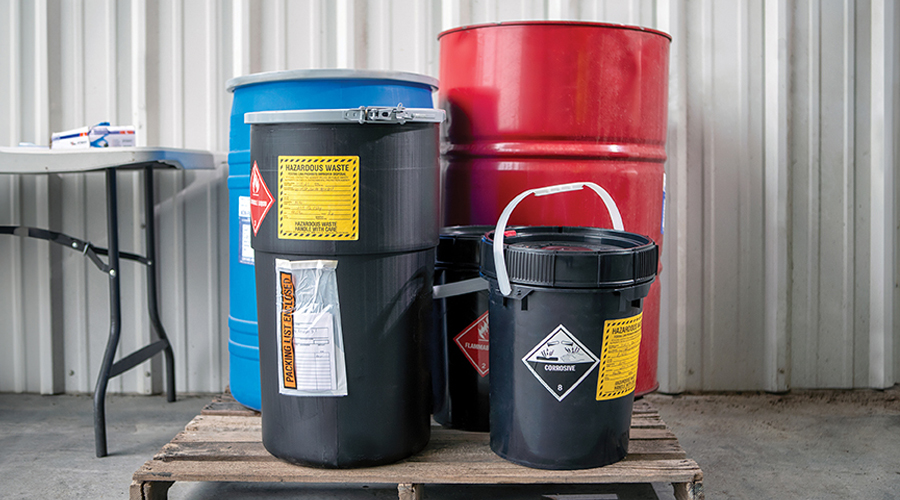
Hazardous waste containers must be properly labeled to ensure anyone who handles it can identify potential hazards and manage the material safely.
- At a minimum, hazardous waste labels should include the following:
- The words "Hazardous Waste"
- A description of the contents
- An indication of applicable hazards, such as ignitable, corrosive, reactive or toxic
- The accumulation start date, when required
- Applicable waste codes, if required by state regulations or facility procedures
Additional Labeling Requirements
Depending on the waste type and how it’s managed, these additional requirements may apply:
- DOT shipping descriptions and identification numbers for off-site transportation
- Universal waste markings for eligible universal wastes (like some batteries, pesticides, mercury-containing equipment and lamps)
- State-specific labeling requirements
Always check local regulations to ensure compliance.
More Than Just a Label
Hazardous waste labels help communicate hazards and promote safe management from generation through final disposal. By understanding hazardous waste classifications and the information required on hazardous waste labels, businesses can support compliance efforts while helping protect workers, communities and environment.
To learn how we can help you with sustainable, safe and compliant solutions for your hazardous and non-hazardous waste streams, visit our
RCRA Hazardous Waste FAQ
What is RCRA?
The Resource Conservation and Recovery Act (RCRA) is a federal law enacted in 1976 that establishes a framework for managing hazardous and non-hazardous solid waste. Its primary goal is to protect human health and the environment through proper waste management and disposal practices.
What is RCRA's cradle-to-grave system?
RCRA's cradle-to-grave system tracks hazardous waste from the point it is generated through its final disposal. This system helps ensure hazardous waste is properly managed throughout accumulation, transportation, treatment and disposal.
What are RCRA hazardous waste classifications?
RCRA hazardous waste classifications help identify and manage waste based on its characteristics and origin. Hazardous wastes generally fall into two categories: characteristic wastes and listed wastes. Some wastes may qualify as both.
What is the difference between characteristic waste and listed waste?
Characteristic wastes exhibit one or more hazardous properties, such as ignitability, corrosivity, reactivity or toxicity. Listed wastes appear on one of the EPA's hazardous waste lists based on their source or composition.
What are RCRA waste codes?
RCRA waste codes are used to identify hazardous wastes regulated under RCRA. These codes typically consist of one letter followed by three numbers and help support proper waste classification, management and disposal.
What are the four characteristic hazardous waste categories?
The four characteristic hazardous waste categories are:
- Ignitability (D001)
- Corrosivity (D002)
- Reactivity (D003)
- Toxicity (D004-D043)
What are F-listed wastes?
F-listed wastes are non-specific source wastes generated by a variety of manufacturing and industrial processes. Examples include spent solvent wastes, electroplating wastes and petroleum refinery wastewater treatment sludges.
What are K-listed wastes?
K-listed wastes are industry-specific source wastes generated by industries identified by the EPA, such as petroleum refining, pesticide manufacturing, iron and steel production and inorganic chemical manufacturing.
What are P-listed and U-listed wastes?
P-listed wastes are acutely hazardous unused commercial chemical products. U-listed wastes are unused commercial chemical products that are hazardous but not as acutely toxic as P-listed wastes. To qualify as either P- or U-listed, the chemical must be listed by the EPA, unused and in the form of a commercial chemical product.
What information must be included on a hazardous waste label?
At a minimum, hazardous waste labels should include:
- The words "Hazardous Waste"
- A description of the contents
- An indication of applicable hazards, such as ignitable, corrosive, reactive or toxic
- The accumulation start date, when required
- Applicable waste codes, if required by state regulations or facility procedures
Are there additional RCRA labeling requirements?
Yes. Depending on the waste type and how it is managed, additional requirements may include DOT shipping descriptions and identification numbers for off-site transportation, universal waste markings and state-specific labeling requirements.
Do hazardous waste labeling requirements vary by state?
Yes. Some states have stricter classifications, additional waste categories or additional labeling requirements. Always check local regulations to ensure compliance.
Why are hazardous waste labels important?
Hazardous waste labels help communicate hazards, support safe handling and promote proper waste management from generation through final disposal. They also help businesses support regulatory compliance while protecting workers, communities and the environment.


